Should You Build or Buy an eCommerce Website?
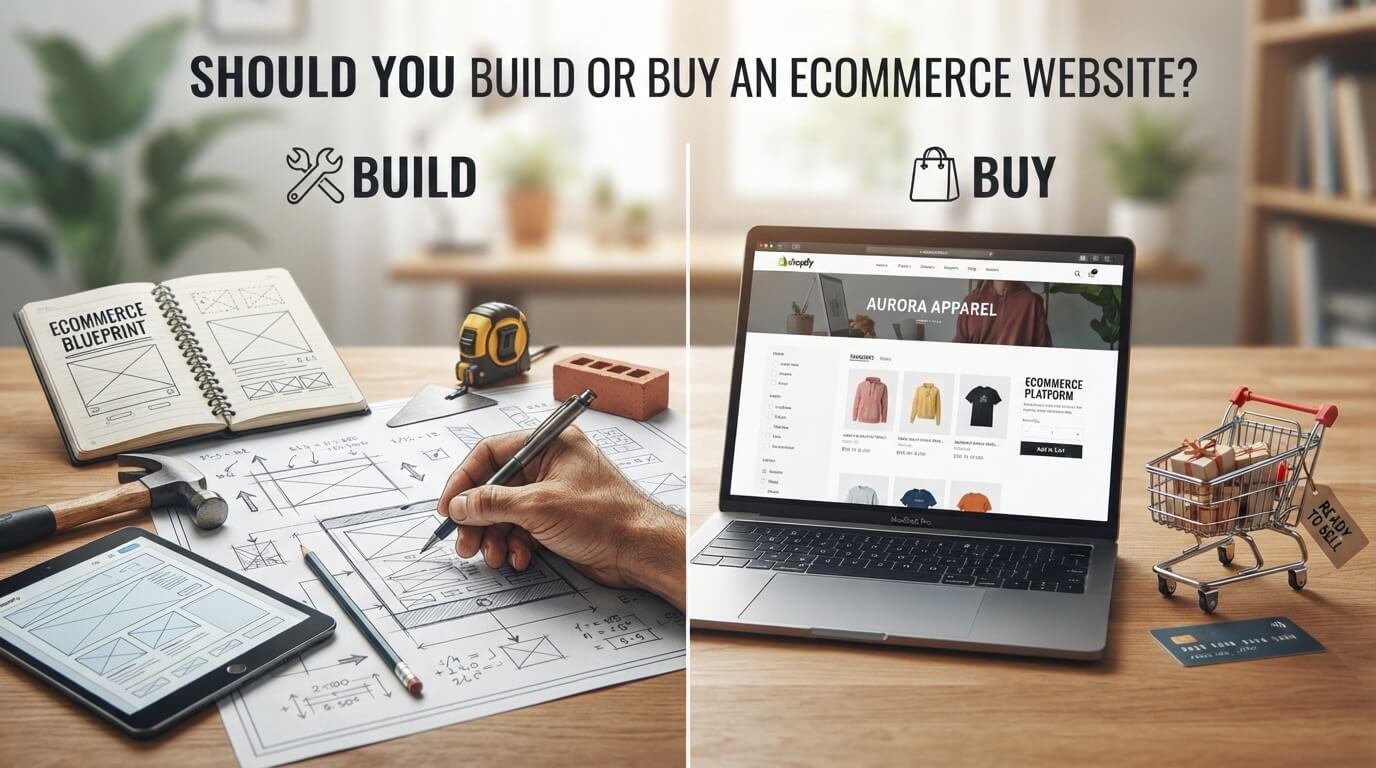
Deciding whether to build or buy an digital storefront is one of the most critical technology decisions a growing enterprise can make. The optimal choice depends heavily on your annual recurring revenue (ARR), system customization requirements, time-to-market constraints, and internal engineering capabilities. For early-stage merchants, purchasing or subscribing to a turnkey SaaS solution offers lower initial capital expenditure (CapEx) and rapid deployment. Conversely, mid-market and enterprise businesses facing complex operational logic, bespoke ERP integrations, or platform fee penalties usually find that custom development yields a significantly lower 3-to-5-year Total Cost of Ownership (TCO) alongside superior digital ecosystem control.
When evaluating this decision, stakeholders must analyze not just immediate setup costs, but long-term operational expenditure (OpEx), transaction tax percentages, feature extensibility, and digital supply chain integration. A custom architecture provides total ownership over intellectual property, conversion rate optimization (CRO) strategies, and database management. On the other hand, commercial off-the-shelf platforms trade bespoke functionality for managed security compliance, infrastructure scaling, and turnkey maintainability. Aligning your strategic choice with your multi-year business roadmap ensures scalable commerce operations without accumulating prohibitive technical debt.
Decoding the Core Dilemma: Building vs. Buying an eCommerce Platform
The global commerce software sector has evolved beyond simple template-driven web pages into sophisticated, decoupled ecosystems. To navigate this landscape, decision-makers must distinguish between three distinct execution pathways: building a fully custom architecture, licensing a commercial Software-as-a-Service (SaaS) solution, or acquiring an already operational web business asset.
Building a proprietary system—whether through monolithic open-source frameworks or modern composable headless architecture—grants full source code accessibility. This methodology empowers engineering teams to craft bespoke logic around product configurators, multi-currency fulfillment networks, and personalized buyer journeys. Engaging in professional eCommerce Development allows organizations to tailor database schemas and API webhooks specifically around existing enterprise operational software, eliminating the functional compromises mandated by pre-packaged platforms.
Buying, by contrast, encompasses two operational vectors. First, licensing a multi-tenant SaaS platform (such as Shopify, BigCommerce, or Salesforce Commerce Cloud) grants immediate access to pre-built checkout pipelines, payment gateway integrations, and managed hosting infrastructure. Second, purchasing an existing, cash-flowing digital store provides established domain authority, operational supplier pipelines, and historical customer profiles. While buying grants immediate operational capability, it introduces platform constraints, revenue-share fees, and potential liabilities within inherited codebase infrastructures.
| Strategic Dimension | Custom Build Architecture | Commercial SaaS (Buy Subscription) | Acquire Existing Digital Store |
|---|---|---|---|
| Initial Capital Outlay | High (Significant upfront engineering) | Low to Moderate (Setup & themes) | High (Valuation purchase multiple) |
| Time to Market | 3 to 9 Months | 1 to 6 Weeks | Immediate (Post-acquisition handover) |
| Feature Flexibility | Unrestricted (Bespoke workflows) | Restricted to API & App ecosystem | Dependent on underlying tech stack |
| Recurring Overhead | Hosting, security patches, maintenance | Monthly subscription + transaction fees | Operational overhead + legacy maintenance |
| IP & Asset Ownership | 100% Proprietary Ownership | Leased infrastructure / Limited access | Full ownership of store assets |
The Strategic Arguments for Building a Custom Digital Storefront
For organizations with unique operational requirements or enterprise-grade scaling ambitions, off-the-shelf platforms often become restrictive constraints rather than growth enablers. Developing a tailored web application establishes a defensible competitive moat around customer experiences and operational efficiency.
1. Absolute System Customization and Unique Business Logic
Standard SaaS platforms cater to the lowest common denominator of business processes. If your commerce strategy relies on complex tier-pricing matrices, multi-warehouse routing, custom product builders, or hybrid B2B/B2C workflows, pre-packaged software often breaks down. Building a system from the ground up enables complete alignment with specialized business models. Every workflow, from checkout fields to customer dashboard portals, is engineered to suit your explicit operational metrics.
This structural freedom extends directly to product presentation. By executing comprehensive custom UX UI Design Services, brands break away from ubiquitous cookie-cutter grid templates. Tailored user interactions increase customer engagement, build brand trust, and drive higher overall average order values (AOV) by eliminating frictional steps in the purchasing funnel.
2. Seamless Integration with Core Enterprise Architecture
Enterprise trade relies on seamless communication between sales platforms, resource planning platforms, customer databases, and warehouse tracking tools. Turnkey platforms often require expensive third-party middleware connectors that introduce latency, synchronization failures, and security vulnerabilities.
Custom engineering facilitates deep, native integration into foundational infrastructure. Modern enterprise systems demand robust business system development to ensure order data flows automatically to fulfillment nodes in real time. Direct API architectures eliminate manual data entry, streamline automated order fulfillment, and maintain unified inventory records across global warehouse facilities. Furthermore, custom backend logic enables direct, high-speed synchronisation with custom CRM Development frameworks, consolidating user profiles, order histories, and automated loyalty tracking under unified customer profiles.
3. Long-Term Financial Optimization at High Transaction Volumes
While custom platforms require larger upfront software engineering investments, their ongoing operational unit economics become increasingly advantageous as gross merchandise value (GMV) scales. Commercial SaaS solutions frequently apply transactional cut-off percentage fees alongside monthly subscription tiers. For businesses generating tens of millions in gross sales, these variable transaction fees quickly outpace the fixed infrastructure hosting costs of a self-hosted custom architecture.
By owning the platform, enterprise operators retain total control over payment processing partnerships, negotiating directly with merchant acquirers for wholesale transaction rates without platform-imposed markups or penalty fees for third-party payment engines.
The Financial and Operational Realities of Buying a Turnkey Solution
Despite the long-term advantages of custom software, buying an existing asset or subscribing to a fully managed platform remains a compelling path for many organizations. Speed, operational simplicity, and low initial capital expenditure are key drivers behind this strategy.
Accelerated Market Deployment and Turnkey Operations
Time-to-market is a critical variable in competitive retail landscapes. Building custom digital systems requires extensive product discovery, sprint planning, wireframing, frontend development, and rigorous quality assurance testing. This execution timeline typically spans several months. Subscribing to an established SaaS platform or acquiring a running business asset reduces launch timelines from months to days.
Turnkey solutions come pre-configured with functional core modules: security compliance, primary payment gateway connectors, mobile checkout capabilities, and standardized product data structures. This enables businesses to validate product demand, execute marketing campaigns, and generate revenue instantly.
Eliminating Backend Infrastructure Overhead
Maintaining high-availability web applications requires continuous server provisioning, load balancing during peak traffic events, database optimization, and compliance updates (such as PCI-DSS and GDPR guidelines). When you build a custom platform, these responsibilities fall on your internal engineering team or an outsourced tech partner.
When you buy into a managed ecosystem, the platform provider assumes infrastructure responsibility. System updates, security patches, auto-scaling server management, and content delivery network (CDN) routing are fully managed under the provider’s SLA. This structure minimizes the immediate requirement for a dedicated on-call engineering team to manage platform operations.
| Operational Dimension | Built Custom Environment | Bought SaaS Solution |
|---|---|---|
| Security & PCI Compliance | Self-managed / Hosted partner responsibility | Fully platform managed (Level 1 PCI) |
| Infrastructure Scaling | Custom cloud configuration (AWS/GCP/Azure) | Automated multi-tenant cloud scaling |
| Third-Party Ecosystem Integration | Custom REST/GraphQL API connections | Pre-built App Store connectors |
| Core Software Updates | Manual developer deployment pipelines | Automatic background platform updates |
Total Cost of Ownership (TCO): A Multi-Year Financial Analysis
A common misstep in web asset evaluation is focusing solely on initial setup costs while overlooking hidden long-term operational expenses. Evaluating the true economic impact over a 3-to-5-year horizon requires analyzing capital expenditure (CapEx), operational expenditure (OpEx), transaction costs, third-party plugin license fees, and ecosystem maintenance resources.
SaaS models appear cost-effective initially, but as transactional velocity increases and third-party operational applications (such as advanced search engines, review widgets, loyalty tools, and multi-currency modules) are stacked, monthly recurring operational costs escalate quickly. Conversely, custom builds concentrate expenses heavily upfront during initial design and engineering phases, followed by stabilized, highly predictable cloud infrastructure management costs.
| Cost Category | Custom Build (Year 1 to Year 3) | Commercial SaaS (Year 1 to Year 3) |
|---|---|---|
| Initial Setup & Engineering | $35,000 – $150,000+ (Upfront CapEx) | $2,000 – $15,000 (Setup & configuration) |
| Platform Licensing / Subscriptions | $0 (Open-source / Proprietary IP) | $3,600 – $36,000+ per year |
| Transaction Processing Surcharges | Direct acquiring bank fees only (~1.2% – 1.8%) | Platform fee + gateway processing (~2.2% – 3.5%) |
| Apps & Plugin Licenses | $0 (Built native to core platform) | $3,000 – $24,000+ annually across app stack |
| Hosting & Cloud Operations | $1,200 – $12,000 annually (AWS/Dedicated) | Included in platform subscription fee |
| Maintenance & Continuous Support | Requires structured website maintenance service | Standard platform tier support |
Evaluating Platform Lock-In and Migration Complexity
Platform lock-in represents a strategic vulnerability for rapidly expanding retail brands. When a company relies entirely on a proprietary SaaS provider, its operational data, backend logic, and user checkout workflows are locked inside a closed technology environment. Should the platform provider alter its pricing structure, impose restrictive terms of service, or sunset critical APIs, the merchant faces significant operational risk.
Transitioning away from a closed SaaS platform requires extracting product catalogs, order records, customer databases, and historical transaction details, then translating them into new data models. Executing a successful website migration involves mapping complex canonical URL redirects, preserving link equity, transferring payment authorization tokens, and synchronizing inventory tracking across channels without downtime.
Conversely, building a custom solution built on open-source framework standards or modern API-first architectures ensures total data sovereignty. Your engineering team retains direct access to full relational database backups, codebase repositories, and configuration scripts. This ownership model allows flexible hosting relocations, custom server optimizations, and full operational independence from third-party vendor strategies.
Strategic Decision Matrix: Which Path Suits Your Business?
To determine whether your enterprise should build or buy, evaluate your operational alignment against key core indicators using the structural evaluation parameters outlined below.
| Strategic Parameter | Choose to BUY (SaaS / Turnkey) If: | Choose to BUILD (Custom System) If: |
|---|---|---|
| Annual Revenue (ARR) | Under $1,000,000 ARR | Over $3,000,000 ARR or rapid enterprise growth |
| Operational Workflows | Standard retail sales & single-tier shipping | B2B quote portals, custom manufacturing logic, multi-ERP setup |
| Technical Capability | No internal IT / reliance on non-technical staff | Access to dev resources or dedicated tech partners |
| Time Horizon | Need to launch within weeks to capture market trend | Building multi-year scalable asset with custom IP |
| Integration Requirements | Standard payment gateways & basic email tools | Custom legacy systems, bespoke CRMs, custom fulfillment APIs |
Operational Evaluation Checklist
Run your core operational framework through this diagnostic decision checklist before committing resources to either track:
- Uniqueness of Purchasing Funnel: Does your product require complex dynamic configuration or customized pricing tables that standard checkout systems cannot support?
- Database Autonomy: Does your industry demand complete control over where customer and transactional data is stored to ensure compliance with strict privacy regulations?
- Total Ecosystem Interoperability: Do your core operational processes rely on legacy enterprise platforms that require custom API connectors?
- Financial Thresholds: Are your annual platform transaction fees and third-party app subscriptions approaching or exceeding the cost of hiring specialized software engineering services?
Execution Framework: Implementation and Continuous Growth
Whether choosing to build a bespoke application or migrate to an upgraded architecture, execution determines project success. High-performing digital platforms rely on modern, responsive, optimized code to deliver performant experiences that maintain conversion rates across desktop and mobile devices.
In initial discovery phases, engaging strategic experts for specialized website design services ensures structural user flows align directly with behavioral purchasing drivers. Visual interface layouts must balance aesthetics with rapid content loading and clean accessibility standards.
As functional demands scale, engineering shifts toward robust structural website development to construct robust data pipelines, build server-side rendering protocols, and establish automated deployment environments. Establishing reliable code architectures minimizes continuous maintenance overhead and allows rapid iterative feature deployment.
Furthermore, managing complex multi-system operations requires connected workflow automation. Partnering with technology leaders like High10 helps organizations integrate intelligent backend automation pathways, eliminating manual data entry, syncing order states, and connecting fulfillment software seamlessly across your web stack.
| Implementation Milestone | Key Deliverables | Primary Risk Mitigation |
|---|---|---|
| 1. Architectural Discovery | Technical requirements doc, database scheme, API mapping | Prevents scope creep and architectural rework |
| 2. Interface & UX Engineering | Wireframes, interactive prototypes, accessibility design | Ensures high conversion rates and intuitive buyer UX |
| 3. Core System Development | Custom codebase build, backend integrations, DB configuration | Reduces technical debt through clean modular code |
| 4. Integration & Automation | ERP, CRM, payment gateway, workflow automation links | Validates system-wide data integrity and sync speed |
| 5. QA, Security & Launch | Penetration testing, load stress testing, SEO redirect mapping | Eliminates post-launch downtime and search visibility loss |
Expert Perspectives: Real-World Enterprise Scenarios
Scenario A: The Scaled B2B Distributor
A mid-market industrial supply company selling over 15,000 SKUs operated on a popular SaaS commerce tier. As transaction volumes expanded, they encountered severe operational roadblocks: their legacy ERP could not synchronize complex customer-specific tiered contract pricing within the limits of the platform’s API rate structures. The app integration layer frequently failed, leading to incorrect invoicing and customer friction. Transitioning to a custom decoupled system enabled direct database synchronization with their internal ERP, automated dynamic client pricing calculations, and reduced operational overhead significantly.
Scenario B: The Emerging D2C Lifestyle Brand
An early-stage direct-to-consumer apparel brand needed to validate market demand rapidly with limited seed capital. Building a complex custom web system would have consumed critical cash reserves needed for initial product manufacturing and customer acquisition marketing. By leveraging a turnkey SaaS engine, the brand launched within three weeks, utilizing pre-built payment gateways and standardized shipping app extensions. This enabled them to focus capital on brand acquisition channels until revenue scaled past the thresholds where platform limitations applied.
Is it cheaper to build or buy an eCommerce website?
In the short term, buying a SaaS subscription or using off-the-shelf software is significantly cheaper due to minimal upfront engineering costs. However, over a 3 to 5-year timeline, high-volume businesses generating over $3M in ARR often find custom builds more cost-effective because they eliminate platform percentage fees, payment gateway surcharges, and recurring app subscription stacks.
What is the typical timeline for custom eCommerce development vs. SaaS deployment?
Deploying a pre-built SaaS storefront typically requires 1 to 6 weeks, depending on design customization and catalog complexity. Developing a custom platform involves architectural planning, UI/UX design, custom backend coding, integrations, and security testing, which generally takes 3 to 9 months.
When should a business consider migrating from SaaS to a custom architecture?
A business should consider migrating when platform limitations restrict functional growth, when custom enterprise system integrations become impossible through standard APIs, when monthly platform fees and app subscriptions exceed continuous maintenance costs, or when bespoke checkout/pricing customization is required to maintain a competitive advantage.
What are the risks of buying an existing operational eCommerce store?
Acquiring an existing web business involves risks such as inherited technical debt, outdated codebase dependencies, hidden SEO penalties, unoptimized hosting environments, poor vendor lock-in, and unreliable historical analytics. A thorough technical audit of the platform codebase and server setup is critical before completing an acquisition.
How does platform choice impact website performance and SEO visibility?
Custom-built platforms allow engineering teams to write clean, minimal code tailored specifically to Core Web Vitals, optimizing load speeds, server-side rendering, and dynamic routing. SaaS platforms offer ease of use but often carry bloat from third-party app scripts, locked server parameters, and restricted HTML template controls that can hinder technical search optimization.
Not sure how this applies to your business?
A 45 minute call, no cost, no obligation. You leave with a scope, an honest timeline and a fixed written quote.