Should I Redesign My Website? 10 Signs It’s Time
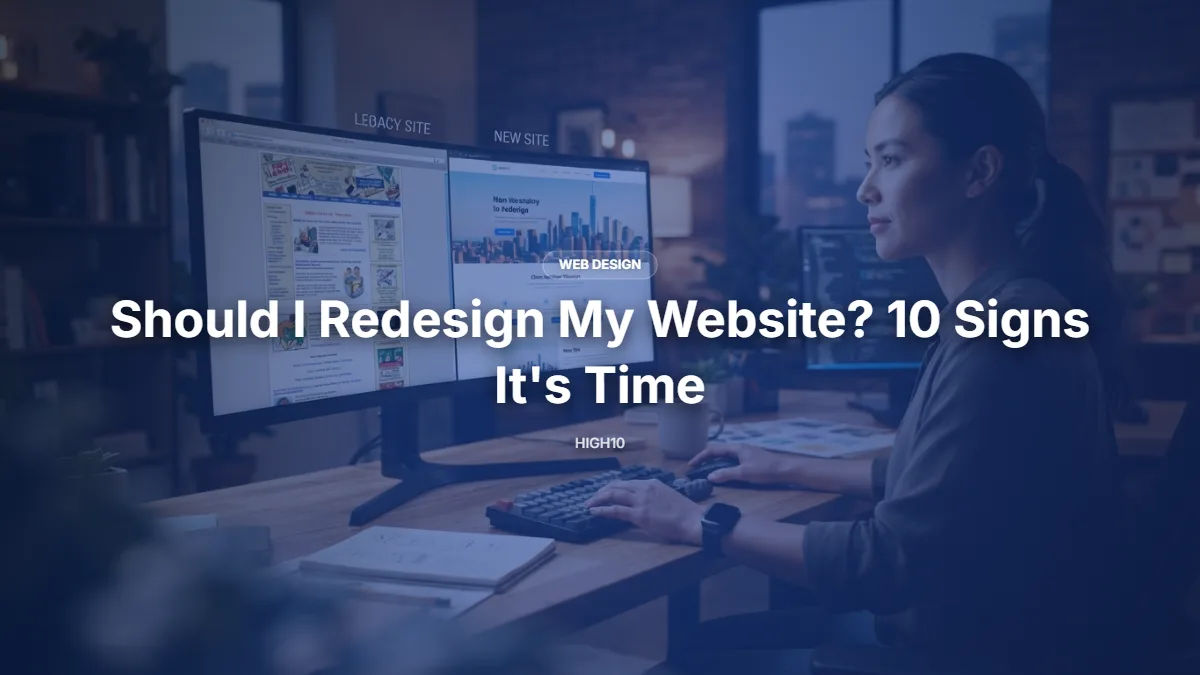
Deciding when to redesign your website is one of the most critical digital strategy decisions your business will make. A website is no longer just a static digital brochure; it is your primary sales engine, brand ambassador, and customer service portal. Generally, you should redesign your website if it has been more than three to five years since your last update, if your conversion rates are steadily declining, or if your site fails to provide a seamless mobile experience. Additionally, if your business has evolved but your digital presence remains anchored in the past, a strategic overhaul is necessary to realign your platform with your current commercial goals.
When a website falls behind modern technical, aesthetic, and functional standards, it directly impacts your bottom line. Search engines prioritize user experience, fast loading speeds, and structured content. If your site lacks these elements, your organic visibility will decline, driving potential clients directly into the arms of your competitors. In this comprehensive guide, we will explore the ten definitive signs that indicate it is time for a redesign, analyze the differences between minor updates and complete overhauls, and outline a roadmap to execute a highly successful website transformation.
The Strategic Dilemma: Website Redesign vs. Website Refresh
Before committing budget and resources to a full overhaul, it is essential to understand whether your business requires a complete website redesign or a simpler website refresh. These two approaches serve different purposes, involve different levels of risk, and require varying levels of investment.
A website refresh is akin to applying a fresh coat of paint and updating the furniture in a home. The underlying structure, database, and content management system (CMS) remain identical, but the visual elements—such as color palettes, typography, imagery, and minor layout adjustments—are modernized. This is ideal for brands that have a highly functional, fast, and SEO-optimized site but need to align their aesthetics with updated brand guidelines.
In contrast, a website redesign is a structural, functional, and architectural reconstruction. It involves changing the underlying CMS, restructuring the information architecture, rebuilding the user flows, optimizing database queries, and completely rewriting or restructuring the codebase. A redesign addresses deep-seated technical issues, improves backend usability for content editors, and integrates advanced marketing technologies.
| Factor | Website Refresh (Evolutionary) | Website Redesign (Revolutionary) |
|---|---|---|
| Core Focus | Aesthetics, visual updates, typography, and color schemes. | Information architecture, UX/UI, technical SEO, and infrastructure. |
| CMS & Backend | Keeps the existing CMS and backend configuration. | Often involves migrating to a modern CMS or headless architecture. |
| SEO Risk | Minimal; URL structures and page templates remain intact. | Moderate to High; requires a strict 301 redirect strategy and migration plan. |
| Development Time | 2 to 6 weeks depending on scale. | 3 to 6+ months of planning, design, and development. |
| Average Lifespan | 1 to 2 years before a structural update is needed. | 3 to 5+ years with regular maintenance. |
| Typical ROI Focus | Immediate boost in brand perception and micro-conversions. | Long-term organic growth, lower bounce rates, and higher conversion rates. |
Understanding which path your business needs to take prevents over-investing in a massive project when a simple visual update would suffice, or conversely, wasting budget on cosmetic changes when your site suffers from systemic technical failure. If your site is experiencing any of the ten symptoms detailed below, a full redesign is the correct strategic choice.
10 Critical Signs It Is Time to Redesign Your Website
1. High Bounce Rates and Declining User Engagement
If your analytics dashboard reveals a steady increase in bounce rates alongside a decline in average session duration, your audience is sending you a clear message: your website is not meeting their expectations. A high bounce rate often points to fundamental flaws in your site’s usability, layout, or content relevance.
Modern users demand immediate gratification. If they arrive on a page and cannot intuitively find the information they seek within three seconds, they will return to the search results. This issue is frequently caused by cluttered layouts, confusing navigation menus, or a lack of clear visual hierarchy. To diagnose and correct these friction points, businesses frequently invest in professional UX UI Design Services to map out intuitive customer journeys that guide visitors naturally toward high-value conversion actions.
2. Poor Mobile Responsiveness and Mobile Usability Failures
With mobile devices accounting for over half of global web traffic, a mobile-first approach is no longer optional. Search engines utilize mobile-first indexing, meaning they evaluate and rank your website based primarily on how it performs on mobile viewports. If your desktop site looks spectacular but your mobile version requires pinch-to-zoom, features broken menus, or hides crucial call-to-action buttons, your business is losing both visibility and revenue.
A truly responsive design dynamically adapts to any screen size, from ultra-wide desktop monitors to compact smartphones. Common mobile usability failures include:
- Clickable elements located too close together, leading to accidental taps.
- Text that is too small to read without zooming.
- Intrusive interstitials or pop-ups that block the primary content.
- Horizontal scrolling caused by unoptimized images or rigid container widths.
3. Slow Page Load Times and Poor Core Web Vitals
Speed is a foundational pillar of user experience and search engine performance. Modern performance standards are defined by Core Web Vitals—a set of specific metrics that measure visual stability, loading performance, and interactivity. If your website takes longer than two seconds to load, bounce rates skyrocket exponentially.
| Metric | What It Measures | Ideal Target | Business Impact of Poor Scores |
|---|---|---|---|
| LCP (Largest Contentful Paint) | Loading performance (how fast the main content loads). | Under 2.5 seconds | Frustrates users; leads to immediate abandonment. |
| INP (Interaction to Next Paint) | Interactivity (how responsive the page is to user inputs). | Under 200 milliseconds | Makes the site feel sluggish, broken, or unresponsive. |
| CLS (Cumulative Layout Shift) | Visual stability (do elements jump around during loading?). | Under 0.1 | Causes accidental clicks; degrades user trust. |
Legacy websites often suffer from bloated code, uncompressed images, redundant tracking scripts, and outdated hosting configurations. If optimization attempts fail to bring your site within these green thresholds, the underlying codebase is likely too inefficient to salvage, requiring a clean rebuild during a complete website development project.
4. Your Brand Identity or Business Goals Have Shifted
A company is a living entity that evolves over time. Your business may have started by offering a single service but has since expanded into enterprise solutions, or perhaps you have pivoted your target audience from budget-conscious consumers to premium corporate clients. If your website still reflects who you were five years ago rather than who you are today, it is actively misrepresenting your brand.
When your brand identity undergoes a transformation, your digital footprint must mirror that evolution. A redesign allows you to align your messaging, color psychology, imagery, and content architecture with your current positioning, ensuring that every visitor receives a cohesive and accurate impression of your capabilities.
5. An Outdated, Insecure, or Hard-to-Manage CMS
Your marketing team should be able to publish landing pages, update copy, and post blog articles without requiring assistance from a developer. If your current Content Management System (CMS) is so complex or rigid that minor edits require custom coding, your marketing agility is severely compromised.
Furthermore, outdated platforms present significant security vulnerabilities. Legacy CMS installations that do not receive regular patches are prime targets for malicious actors. Transitioning to a secure, user-friendly CMS through a comprehensive website maintenance service or redesign ensures your team can work efficiently while keeping your digital assets protected against modern cyber threats.
6. Declining Organic Traffic and Outdated SEO Architecture
Search engine algorithms are continuously updated to prioritize structured, semantic, and highly accessible content. If your website was built during an era when keyword stuffing and flat HTML layouts were the norm, it will struggle to rank in modern search landscapes.
An outdated SEO architecture often features poor internal linking, duplicate content issues, lack of schema markup, and messy URL paths. A redesign provides an opportunity to restructure your entire site taxonomy, construct a clean XML sitemap, implement JSON-LD structured data, and build an optimized directory system that helps search crawlers easily index and understand your content.
7. High Friction in the Conversion Funnel
Traffic is a vanity metric if those visitors do not convert into leads, subscribers, or customers. If your analytics reveal that users are entering your site but dropping off at critical points—such as the checkout page, contact form, or sign-up sheet—your conversion funnel contains excessive friction.
Friction can take many forms: contact forms with too many mandatory fields, confusing payment gateways, lack of trust signals (such as SSL certificates or client testimonials), or vague calls-to-action (CTAs). A modern redesign focuses heavily on conversion rate optimization (CRO), streamlining the path to purchase and removing any cognitive load that prevents a user from completing an action.
8. Your Competitors Just Relaunched and Look Miles Ahead
In business, you do not operate in a vacuum. Your prospects are constantly comparing your digital presence against your direct competitors. If your competitors have recently launched sleek, fast, and highly interactive websites while yours looks like a relic of the early 2010s, you are operating at a massive disadvantage.
An outdated website signals to prospective clients that your business may also be outdated in its operations, technology, and customer service. By observing what your competitors do well—and where their new sites fall short—you can design a platform that surpasses industry standards and positions your brand as the modern leader in your market.
9. Third-Party Integrations are Broken or Unsupported
Modern businesses rely on an ecosystem of software tools, including Customer Relationship Management (CRM) platforms, email marketing software, inventory databases, and payment processors. If your website relies on legacy APIs or outdated plugins that no longer sync correctly with these external tools, your operational efficiency will suffer.
When integrations break, your team is forced to rely on manual data entry, which introduces human error and delays response times. During a redesign, you can implement robust, modern API integrations and leverage High10’s workflow automation solutions to streamline your business operations, ensuring that lead data, inventory levels, and customer records sync seamlessly in real time across all systems.
10. Security Vulnerabilities and Outdated Code
The web development landscape changes rapidly. Code written five years ago may contain deprecations, inefficient queries, or security loopholes that make your website vulnerable to SQL injections, cross-site scripting (XSS), and brute-force attacks. If your site is still running on HTTP instead of HTTPS, browsers will flag it as “Not Secure,” instantly destroying visitor trust.
A website redesign allows you to build a clean, modern codebase from scratch. By utilizing the latest development frameworks, secure coding practices, and robust hosting environments, you protect your business from devastating data breaches and ensure compliance with global privacy regulations like GDPR and CCPA.
The Website Redesign Roadmap: A Phase-by-Phase Framework
A successful website redesign is not a chaotic creative exercise; it is a structured, disciplined process that requires careful planning, execution, and post-launch monitoring. To ensure your project stays on schedule, within budget, and achieves its strategic objectives, it is best to follow an industry-standard development lifecycle.
| Phase | Key Activities | Deliverables |
|---|---|---|
| 1. Discovery & Strategy | Stakeholder interviews, competitor analysis, audience persona mapping, and SEO audit. | Creative brief, technical specification document, and sitemap. |
| 2. UX/UI Design | Wireframing, user flow mapping, responsive layout design, and design system creation. | Figma prototypes, UI style guides, and approved page layouts. |
| 3. Development | Frontend coding, backend CMS integration, database setup, and custom feature programming. | Staging site, clean codebase, and functional API integrations. |
| 4. Content & SEO Migration | Content rewriting, metadata optimization, image compression, and 301 redirect mapping. | Optimized content database and 301 redirect file. |
| 5. Quality Assurance (QA) | Cross-browser testing, mobile responsiveness checks, form testing, and speed optimization. | QA bug report and performance audit scorecards. |
| 6. Launch & Monitoring | Domain mapping, SSL installation, analytics tracking setup, and search engine indexing. | Live production website and active monitoring dashboards. |
Skipping any of these phases can lead to project delays, budget overruns, or a launch that fails to deliver the expected business results. For instance, launching a beautiful new design without a meticulous SEO migration strategy can cause your search engine rankings to collapse overnight.
Protecting Your Organic Traffic During a Website Migration
One of the greatest fears businesses have when redesigning their website is losing their hard-earned search engine rankings. This fear is justified: if your URL structures change, if content is deleted, or if search engine crawlers cannot find your new pages, your organic traffic can plummet.
To mitigate this risk, you must execute a flawless website migration strategy. This process involves mapping every old URL to its corresponding new URL using permanent 301 redirects. This tells search engines that your content has permanently moved to a new home, preserving your link equity and ranking authority.
| Checklist Item | Action Required | Responsible Party |
|---|---|---|
| 301 Redirect Map | Verify that all legacy URLs redirect correctly to active new pages without loops or 404 errors. | SEO Specialist / Developer |
| Robots.txt Verification | Ensure the robots.txt file does not block search engines from crawling the new production site. | Web Developer |
| XML Sitemap Submission | Generate a new XML sitemap and submit it to Google Search Console and Bing Webmaster Tools. | SEO Specialist |
| Analytics Tracking Verification | Confirm that Google Analytics 4 (GA4) and tag managers are firing correctly on all pages. | Digital Marketer |
| SSL Certificate Check | Verify that the SSL certificate is active and all HTTP traffic successfully redirects to HTTPS. | Systems Administrator |
By executing these checks immediately upon launch, you can transition to your new website smoothly, preserving your organic visibility while capitalizing on the performance improvements of your updated platform.
Calculating the ROI of a Website Redesign
A website redesign is a significant capital investment. To justify this expenditure to stakeholders, you must establish clear, measurable Key Performance Indicators (KPIs) before the project begins. The Return on Investment (ROI) of a redesign is not calculated solely by immediate sales; it is measured across several operational and marketing metrics.
- Conversion Rate Increase: If your current site has a 1% conversion rate on 50,000 monthly visitors (500 leads), and a redesigned site with improved UX achieves a 2% conversion rate (1,000 leads), you have doubled your lead generation without spending an extra dollar on advertising.
- Reduced Customer Support Burden: By integrating comprehensive self-service portals, clear FAQs, and automated chatbots, you can significantly reduce the volume of basic support inquiries reaching your team, lowering operational costs.
- Lower Customer Acquisition Costs (CAC): Improved organic rankings and better on-page conversion rates mean you spend less on paid acquisition channels to acquire the same volume of customers.
- Admin Efficiency: A modern CMS allows your marketing team to publish content instantly, eliminating developer bottlenecks and reducing ongoing maintenance expenses.
Choosing the Right Partner for Your Redesign Project
Embarking on a website redesign is a complex endeavor that requires a blend of creative design, technical development, search engine optimization, and strategic marketing expertise. Partnering with the right agency makes the difference between a stressful project that misses deadlines and a seamless, highly successful digital transformation.
When evaluating potential partners, look for agencies that offer comprehensive, end-to-end solutions. A team that can handle everything from initial website design services to advanced website redesign services ensures that your strategic vision is maintained throughout the entire lifecycle of the project. High10 stands as a trusted digital partner, helping businesses navigate complex redesigns, integrate advanced marketing automations, and build high-performing web platforms that drive sustainable business growth.
Not Sure Where to Start? Download Our Website Redesign Guide
How often should a business redesign its website?
On average, businesses should consider a website redesign every 3 to 5 years. This timeframe aligns with major shifts in web design aesthetics, search engine algorithm updates, mobile technology evolution, and security standards. However, if your business model changes or your site’s performance metrics begin to decline sooner, you should initiate a redesign project immediately.
Will a website redesign hurt my current Google rankings?
If executed incorrectly, a website redesign can cause a temporary or even permanent drop in organic traffic. However, by implementing a strict website migration plan, establishing a comprehensive 301 redirect map, maintaining consistent metadata, and preserving high-performing content assets, you can protect and eventually improve your organic search rankings.
How long does a typical website redesign project take?
A standard website redesign project typically takes between 12 to 24 weeks. The timeline depends heavily on the complexity of the site, the number of pages, the depth of custom integrations required, and the speed of content production. Simple informational sites can be completed faster, while complex e-commerce platforms or enterprise portals may take six months or longer.
What is the average cost of a professional website redesign?
The cost of a website redesign varies widely based on the scale and complexity of the project. A custom-designed, optimized website for a small to medium-sized business typically ranges from $5,000 to $20,000. Enterprise-level websites with complex database integrations, custom portals, and advanced security configurations can range from $30,000 to over $100,000.
Not sure how this applies to your business?
A 45 minute call, no cost, no obligation. You leave with a scope, an honest timeline and a fixed written quote.